
You're sent on a residential service call for an AC system that is not cooling properly. Having just finished a large commercial job at a hotel, you clear your mind and get ready for the next one. Remembering that you should not try to pre-diagnose a call.. you can't help but wonder.
The dispatcher tells you that the customer is on her way and will be there shortly. Relieved, you now get a chance to focus on the HVAC system and not the customer for a while.
A good technician is an investigator, so you throw a nut driver in your pocket and leave the rest of your tools in your truck. You locate the condensing unit on the side of the house... covered in bushes. Somewhere you learned that the installer's guide recommends 8"-12" of clearance from the coil to allow for proper airflow.
Upon further investigation, you see this on the other side... a dryer vent. Why do they always put the AC system next to the dryer vent?
Grabbing your nut driver you pop off the cover of the condensing unit, what a mess! You think, "This really needs to be cleaned and the bushes trimmed away." You realize you can't do anything until you give the customer a thorough diagnosis and a recommendation and decide to wait for her.
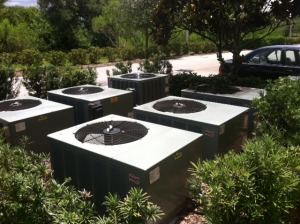
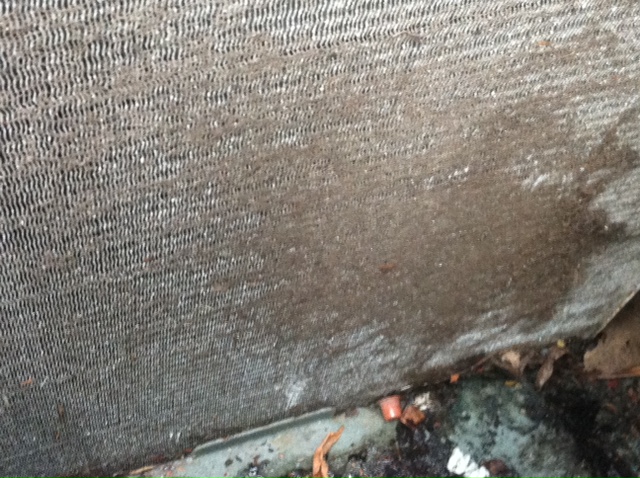
And then, the unit kicks on! Having never seen a condensing coil quite so plugged, and wondering how it affects the system pressures and temps, you run back to your truck and grab your gauges and temp probe. You hook up your gauges and here is what you find:
Before you read your gauges, you check the data plate on the condensing unit and find it is an R410A system. It is so bright outside it is hard to read your low side gauge. You can see the pressure is reading 130 psig. You reach for your PT chart that is in your notebook and cross 130 psig over to 44F of saturation temperature. Hmmm.... you grab your notebook and record the high and low side pressures, temperatures, superheat, and subcooling.
Instead of telling her that the plugged condensing coil causes the saturation temperature to rise, and the high side pressures to rise, and showing her all of your notes. You simply say, "The dryer vent lint plugged your condensing coil. This coil is similar to the radiator of you car and you know what happens when your radiator gets plugged.... it overheats. That is what is happening to your AC system".
You inform her about your companies maintenance plan and that the coil needs to be cleaned before you can properly check the operation of the system. After she gives you the go-ahead to clean the coil, you get busy. After cleaning her coil with your condenser cleaner and a hose (did you remember NOT to hit the coil with a sprayer at full force?) you're anxious to see how everything changed.
Once again you hook up your gauges, remembering to read the pink temp ring, and here is what you find:
Once again you get out your notebook and record:
You think back to Module 3 and recall, a system with a TXV, can maintain pressures and superheat over a wide range of conditions.
This makes you wonder what would have happened to the low side pressure and superheat with a fixed orifice metering device?
by Ron Walker
The dispatcher tells you that the customer is on her way and will be there shortly. Relieved, you now get a chance to focus on the HVAC system and not the customer for a while.
A good technician is an investigator, so you throw a nut driver in your pocket and leave the rest of your tools in your truck. You locate the condensing unit on the side of the house... covered in bushes. Somewhere you learned that the installer's guide recommends 8"-12" of clearance from the coil to allow for proper airflow.
Upon further investigation, you see this on the other side... a dryer vent. Why do they always put the AC system next to the dryer vent?
Grabbing your nut driver you pop off the cover of the condensing unit, what a mess! You think, "This really needs to be cleaned and the bushes trimmed away." You realize you can't do anything until you give the customer a thorough diagnosis and a recommendation and decide to wait for her.
And then, the unit kicks on! Having never seen a condensing coil quite so plugged, and wondering how it affects the system pressures and temps, you run back to your truck and grab your gauges and temp probe. You hook up your gauges and here is what you find:
Before you read your gauges, you check the data plate on the condensing unit and find it is an R410A system. It is so bright outside it is hard to read your low side gauge. You can see the pressure is reading 130 psig. You reach for your PT chart that is in your notebook and cross 130 psig over to 44F of saturation temperature. Hmmm.... you grab your notebook and record the high and low side pressures, temperatures, superheat, and subcooling.
- Lo side..... 130 psig
- Lo side..... 44F saturation temp
- Lo side..... 66F refrig line temp
- Superheat.... 22F
- Hi side.... 450 psig
- Hi side.... 125F saturation temp
- Hi side.... 115F refrig line temp
- Subcooling.... 10F
Instead of telling her that the plugged condensing coil causes the saturation temperature to rise, and the high side pressures to rise, and showing her all of your notes. You simply say, "The dryer vent lint plugged your condensing coil. This coil is similar to the radiator of you car and you know what happens when your radiator gets plugged.... it overheats. That is what is happening to your AC system".
You inform her about your companies maintenance plan and that the coil needs to be cleaned before you can properly check the operation of the system. After she gives you the go-ahead to clean the coil, you get busy. After cleaning her coil with your condenser cleaner and a hose (did you remember NOT to hit the coil with a sprayer at full force?) you're anxious to see how everything changed.
Once again you hook up your gauges, remembering to read the pink temp ring, and here is what you find:
Once again you get out your notebook and record:
- Lo side..... 125 psig
- Lo side..... 40F saturation temp
- Lo side..... 63F refrig line temp
- Superheat.... 23F
- Hi side.... 320 psig
- Hi side.... 100F saturation temp
- Hi side.... 91F refrig line temp
- Subcooling.... 11F
You think back to Module 3 and recall, a system with a TXV, can maintain pressures and superheat over a wide range of conditions.
This makes you wonder what would have happened to the low side pressure and superheat with a fixed orifice metering device?
by Ron Walker